
 Cultural & Heritage Tours
Meet the Artisans – Highlighting Rural Craftsmen and Local Culture
In an era dominated by mass production and fast fashion, India’s rural artisans stand as custodians of a centuries-old heritage. From handwoven textiles to intricate pottery, their craftsmanship is deeply rooted in tradition, storytelling, and sustainable practices. These artisans not only preserve the cultural fabric of the country but also embody India’s rich diversity, where each region has its own unique artistic identity.
In this blog, we take you on a journey across India to meet the master craftsmen, explore their traditional arts, and understand the local cultures that breathe life into these remarkable crafts.
1. Pattachitra Painters of Odisha – The Storytellers in Color
📍 Where? Raghurajpur, Odisha
🎨 Art Form: Pattachitra Painting
Nestled in the quaint village of Raghurajpur, Odisha, lies a community of artisans who have dedicated their lives to the art of Pattachitra painting. This ancient art form, which dates back over 1,000 years, is characterized by intricate detailing, mythological themes, and a unique use of natural colors.
Pattachitra, meaning “cloth painting,” is traditionally done on canvas, palm leaves, or dried scrolls. The artisans use mineral-based natural colors, derived from conch shells, stones, and flowers, ensuring that their art remains sustainable and vibrant for centuries.
🌟 Must-Do Experiences:
✔️ Visit an artisan’s home and witness the entire process, from making natural dyes to painting.
✔️ Try your hand at palm-leaf engraving, another unique craft from the region.
✔️ Purchase authentic Pattachitra artworks directly from the artists to support their livelihood.
2. Kutch’s Ajrakh Block Printers – A 4,000-Year-Old Craft
📍 Where? Ajrakhpur, Gujarat
🎨 Art Form: Ajrakh Block Printing
The desert region of Kutch, Gujarat, is home to the centuries-old Ajrakh block printing tradition. The craft, deeply connected to the Sindhi Muslim Khatri community, involves a meticulous 16-step process using natural dyes and hand-carved wooden blocks.
Ajrakh printing is more than just an art form; it is a symbol of sustainability. Artisans use indigo, pomegranate, turmeric, and rusted iron to create rich colors that mature beautifully over time. Each piece of cloth undergoes multiple washes, ensuring its durability and uniqueness.
🌟 Must-Do Experiences:
✔️ Visit the Ajrakhpur village, where artisans will guide you through the dyeing and printing process.
✔️ Take a block-printing workshop to create your own Ajrakh fabric.
✔️ Explore Bhujodi village, known for its handwoven shawls and Rabari embroidery.
3. Blue Pottery of Jaipur – Rajasthan’s Timeless Ceramic Art
📍 Where? Jaipur, Rajasthan
🎨 Art Form: Blue Pottery
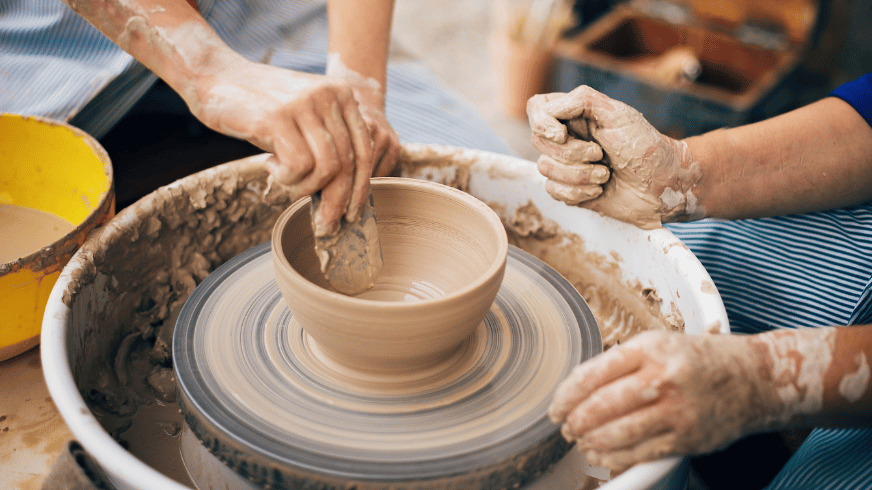
One of Rajasthan’s most exquisite handicrafts, Blue Pottery, traces its origins to Persian and Mughal influences. Unlike conventional clay pottery, this art form uses quartz, glass, and natural minerals, making it non-porous and highly durable.
The vibrant blue, green, and yellow floral motifs seen in Jaipur’s blue pottery are inspired by nature and Mughal architecture. Each piece is handcrafted, painted, and fired at low temperatures, giving it a delicate yet long-lasting finish.
🌟 Must-Do Experiences:
✔️ Visit a Blue Pottery studio in Jaipur to see the artisans at work.
✔️ Buy exquisite handcrafted bowls, plates, and tiles that make for unique souvenirs.
✔️ Try a pottery-making workshop to create your own piece of art.
4. Toda Embroidery – The Sacred Weaves of the Nilgiris
📍 Where? Ooty, Tamil Nadu
🎨 Art Form: Toda Embroidery
In the lush green hills of Ooty, the Toda tribal community practices a rare and intricate form of embroidery, known as Pukhoor (Toda embroidery). Traditionally, Toda women hand-stitch geometric red-and-black designs onto white fabric, creating bold, striking patterns inspired by nature.
What makes Toda embroidery special is that it follows a reverse stitch technique, where the patterns emerge on the opposite side of the fabric. Each embroidered shawl holds cultural significance, often depicting tribal myths and symbols.
🌟 Must-Do Experiences:
✔️ Visit a Toda settlement and learn about their unique way of life.
✔️ Buy authentic Toda embroidered shawls, which take weeks to complete.
✔️ Take a guided walk through the Nilgiri Biosphere Reserve, where the tribe coexists with nature.
5. Warli Paintings – Maharashtra’s Ancient Tribal Art
📍 Where? Palghar, Maharashtra
🎨 Art Form: Warli Painting
The Warli tribe of Maharashtra has been practicing their distinct monochromatic painting style for centuries. Warli art, created using white paint on a mud base, depicts daily village life, nature, and folklore through simple geometric patterns.
Unlike modern paintings, Warli art doesn’t depict gods or deities; instead, it narrates the cycle of life, farming, and community bonding. Traditionally, Warli art was painted on the walls of tribal homes during festivals and weddings.
🌟 Must-Do Experiences:
✔️ Visit a Warli village and watch artisans paint murals on walls.
✔️ Take a workshop to learn the art’s symbolic meaning and storytelling techniques.
✔️ Buy handmade Warli artworks, which support the artisans’ livelihood.
6. Thanjavur Dolls – The Dancing Dolls of Tamil Nadu
📍 Where? Thanjavur, Tamil Nadu
🎨 Art Form: Thanjavur Bommai (Dancing Dolls)
A visit to Tamil Nadu’s temple town of Thanjavur isn’t complete without witnessing the enchanting Thanjavur Bommai, the region’s iconic dancing dolls. These hand-painted, bobble-headed dolls are made from clay and papier-mâché, designed to sway in rhythmic motion.
Thanjavur dolls represent mythological figures, Bharatanatyam dancers, and traditional Indian couples. They are made using eco-friendly materials, keeping the art form sustainable and relevant even today.
🌟 Must-Do Experiences:
✔️ Watch artisans hand-paint the dolls using natural colors.
✔️ Buy authentic Thanjavur dolls directly from local markets.
✔️ Explore the Brihadeeswarar Temple, a UNESCO World Heritage Site.
7. Bamboo Craft of Assam – Sustainable Handicrafts
📍 Where? Majuli, Assam
🎨 Art Form: Bamboo Weaving
The northeastern state of Assam is known for its thriving bamboo craft industry, where artisans create furniture, jewelry, baskets, and home décor using locally grown bamboo.
Majuli, the world’s largest river island, is particularly famous for its eco-friendly bamboo masks and sculptures. These bamboo crafts are completely biodegradable and represent the region’s commitment to sustainable living. The masks, used in Satriya dance performances, bring mythological characters to life in Assamese cultural festivals.
🌟 Must-Do Experiences:
✔️ Visit a bamboo workshop and learn about traditional weaving techniques.
✔️ Watch a live Satriya dance performance, where the masks are used.
✔️ Buy handcrafted bamboo products, including furniture and baskets.
Conclusion
India’s rural artisans are the heart and soul of its cultural heritage. Their handmade crafts, passed down through generations, are not just products but living stories of tradition, resilience, and artistic mastery. By supporting these artisans, we help preserve their art forms and ensure that their craft continues to flourish in a rapidly changing world.
🚀 Which of these crafts would you love to explore? Let us know in the comments!
Bigbet1
December 10, 2025 - 2:37 amBigbet1 is growing on me. The interface is clean and there are lots of ways to win. Giving it a thumbs up! Visit bigbet1
123winonline
December 18, 2025 - 8:28 pmHeard some buzz about 123winonline. Claim they have some good promos going on. Worth checking out to see if you can snag a sweet bonus. Find your win at 123winonline
Alanobet999
December 30, 2025 - 9:57 pmAlanobet999, is that like the super high-roller version? Gonna give it a look. Wonder if they have special VIP bonuses... or maybe just some fancy graphics. Either way, let's see what's up! Check them out here: alanobet999